Tejo wines... building a love story with Quebec
bernardinopaula
May 18
6 min read

At the 2023 edition of the Sélections Mondiales des Vins wine contest, Portugal had 12 medal-winning wines in the competition’s Top 50, including 4 from the Tejo region—specifically the Adega Cooperativa do Cartaxo winery, which stood out with 3 Grand Gold medals and 1 Gold medal for its Bridão brand. Quebec consumers had the opportunity to taste these award-winning wines at the La Grande Dégustation de Montréal event in October 2023. I myself discovered the wines of this Tejo winery there when I met its executive director, Mr. Fausto Silva, and Mr. Luís de Castro, president of the Tejo Regional Wine Commission (Comissão Vitivinícola Regional do Tejo).
Was this the beginning of a love affair with the wines of this Portuguese wine region, or just a simple fling during the fall of 2023?
Like any good story where there seems to be a connection, it was time to explore... and the Tejo wine team returned to Montreal in March 2024, this time to showcase a wider range of wines and vineyards from the region during a masterclass and tasting event. This event allowed industry professionals in Quebec to gain a deeper understanding of this region and its grape varieties. I also learned about the Tejo Wine Route 118, a nearly 150-km wine route created in 2021, featuring 14 producers along the route that are open for visits and tastings. Those interested can also participate in the grape harvest and pick olives at olive oil producers. The region also invites exploration with remarkable estates to visit, such as Quinta da Alorna, Quinta da Lagoalva, and Quinta do Casal Branco.
At this trade show in March 2024, I had the opportunity to work at the Parras Wines booth, where I learned more about Tejo wines, particularly the king of white wine grapes, Fernão Pires, which is widely used in this region. It is also a region that takes pride in recognizing and celebrating its traditions and traditional products. For example, the Parras Wines group distributes a line that pays tribute to the Lusitano horse, a Portuguese breed. Renowned for its elegance, agility, and intelligence, the Lusitano horse is recognized worldwide as one of the most noble breeds for equestrian art. It is this elegance, nobility, and authenticity that the Parras Wines vineyard seeks to convey with this range of wines, two of which won GOLD medals at the 2024 Sélections Mondiales des Vins wine contest.
And then, this love story continued to unfold in the fall of 2024 as the Tejo wine team returned for a masterclass in Quebec City on October 8. The goal of this masterclass was to attract curiosity by showcasing the fascinating diversity of Tejo wines and to conclude that these are world-class wines from terroirs that have remained largely unknown until now.
The Tejo wine region was formerly known as Ribatejo, and the name change took place in 2008. This rebranding was intended to help better identify the region and its characteristics. This wine region is defined by the Tagus River, its warm days, cool nights, and crisp wines. Fernão Pires is the most widely planted white grape variety in Portugal; it is a variety that producers in this region love to work with because of its versatility for different types of white wines: sparkling, single-varietal, blends, and more. For red wines, Castelão is the typical grape variety of the Tejo region.
A rich and luminous territory
Crossed by the majestic Tagus River, the Tejo region enjoys a particularly favorable climate, with 2,800 hours of sunshine per year. Its extraordinary mosaic of soils—sandy, clay, limestone, or schist—offers an infinite range of expressions, which winemakers translate into wines that combine freshness, depth, and balance.
The Tejo wine region, Portugal’s fifth-largest wine-producing region by volume, captivates with its diversity of grape varieties. It is home to iconic varieties such as Fernão Pires, Arinto, Castelão, Trincadeira, and Touriga Nacional, as well as seamlessly integrated international varieties like Alicante Bouschet, Syrah, and Cabernet Sauvignon. The region stands out for the richness of its grape varieties, blending Portuguese varieties with international ones to create creative and flavorful blends that reflect the full expertise of its winemakers.
Serras: a new terroir added to the map
Big news announced in the fall of 2025 during the masterclass in Montreal (and announced in Lisbon in January 2026): the official recognition of a fourth Tejo terroir, named Serras, which is now clearly marked on regional maps. Located in the northernmost part of the region, Serras is distinguished by its schist and marl soils with a clayey texture, as well as by higher rainfall, due to its proximity to the mountains of Portugal’s Central Massif. This terroir, where red wines dominate (65%), brings a more structured and mineral dimension to the Tejo’s identity, confirming the region’s geographical and stylistic richness.
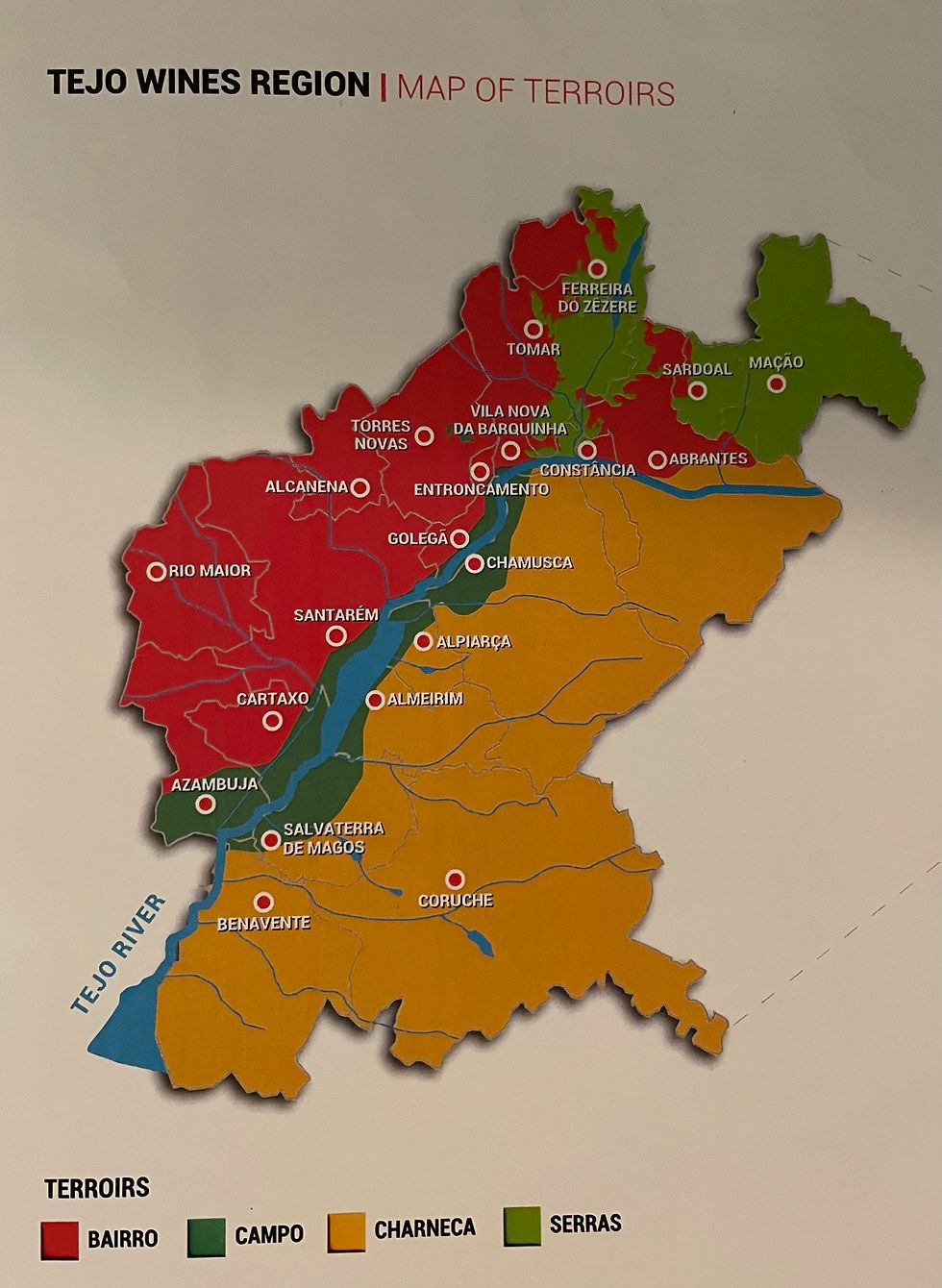
Serras thus joins the three other distinct terroirs of the Tejo wine region:
- Bairro: situated between the Tagus Valley and the Candeeiros, Serra de Aires, and Montejunto mountain ranges, with clay-limestone soils, this is an ideal terroir for red grape varieties.
- Campo: located on the vast plains adjacent to the Tagus River, which are often flooded. These floods are responsible for the high fertility of the soils and make this an excellent area for producing white wines, particularly from the Fernão Pires grape variety. The region’s natural fertility requires precision viticulture. Mornings are foggy and humid. Afternoons are very hot and nights are cold.
- Charneca: located south of Campo, on the left bank of the Tagus, its sandy, moderately fertile soils are suitable for producing both red and white wines. Higher temperatures and a generally warmer, drier climate accelerate grape ripening. The harvest typically begins in early August.
Tejo wines once again distinguished themselves at the 2024 Sélections Mondialed des Vins Portugal had 14 medal-winning wines in the competition’s Top 50, including 3 from the Tejo region: Grand Gold for Adega do Cartaxo’s Detalhe Reserva red, Gold for Quinta da Alorna’s Abafado 5 anos, and Gold for Quinta do Casal Monteiro’s Fernão Pires Grande Reserva. In total, 18 Tejo wines won medals at this 2024 competition, and the news is a source of pride for everyone involved, as highlighted in the headline on the website: Vinhos do Tejo no TOP 50 do concurso Sélections Mondiales des Vins do Canadá 2024. (ENG = Tejo wines in the TOP 50 of the 2024 World Wine Selections of Canada).
Mr. Luís de Castro, president of the Comissão Vitivinícola Regional do Tejo, states in the CVRTejo press release that “being included in this renowned contest is very important from two perspectives: assessing wine lovers’ perception of the wines and their quality, but also boosting sales and opening up new markets. In the case of the Sélections Mondiales des Vins du Canada, the goal is to highlight the products that performed best in the competition, with a view to entering the Canadian and U.S. markets.”
Tejo wines continue to make their mark on the international stage. At the 2025 Sélections Mondiales des Vins du Canada, wines from the region won over 30 gold medals and 3 Grand Gold medals.
What’s next for this love story between Tejo wines and the Quebec market? A serious commitment from one or more agents or agencies to make these wines readily available to Quebec consumers. Who will be the first to make a serious commitment? Tejo wines have actively continued their promotional and business development efforts in Quebec, standing out with a strong presence at the 2026 Spring Raspipav private import trade show from April 25 to 27, with no fewer than 10 producers on site:


Comments